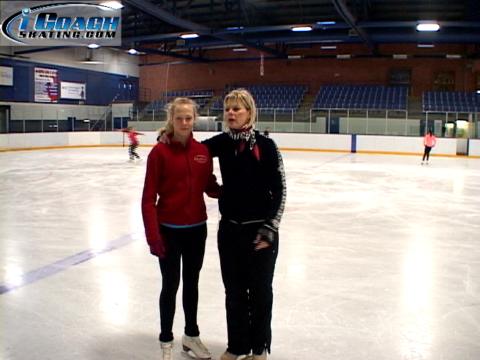
Olympic coach Michelle Leigh shares a simple but valuable setup pattern for single and double axel development. Michelle utilizes the hockey circles on the end of the rink to help the skater keep a consistent entrance pattern to the jump. The pattern takes the guess work out of the entrance and allows the skater to focus on the technique of the jump. What makes this entry pattern unique is the double circle entry. Michelle points out that the same circle size on every attempt helps with jump consistency.
The pattern involves backward crossovers around one of the hockey circles, followed by a controlled step forward to the inside, a Mohawk to backward between the circles, a backward two foot glide on the next circle, and finally transitioning to a backward outside edge slightly on the inside of the circle. Pay attention to the 2 foot “set” backward edge, as this part of the set up is designed to give the skater a moment to “feel” what they are going to feel in the air. This pattern is valuable for single and double axels because the circle serves as a reference point and the skater can think about jumping outside the circle (helpful for eliminating those “spinny” or “swingy” axel take-offs).
Editor: Note that Michelle does NOT have the skater gliding on the backward edge ON the circle (she wants the skater slightly inside the circle) and she does NOT have the skater step ONTO the circle for the forward take-off edge (she wants the skater to step and jump outside the circle). This is somewhat different than many coaches who teach a similar pattern directly on the circle. Video shows that most skaters at the elite level do step slightly out of the circle, making Michelle’s pattern more realistic.
As a bonus, Michelle addresses how to create a more comfortable transition from a single to a double axel. She uses the consistent pattern shown previously in the video along with a twizzle after the landing of the single axel. The twizzle helps the skater get used to continuing the rotation of the single axel. Michelle believes it’s important to begin developing this early on so when the skater begins working on a double axel, rotating past a single axel is not such a foreign concept.

Sorry, this content is for members only.Click here to get access.
Already a member? Login below… |

 Add to “My Favorites” (Beta testing)
Leave a Reply