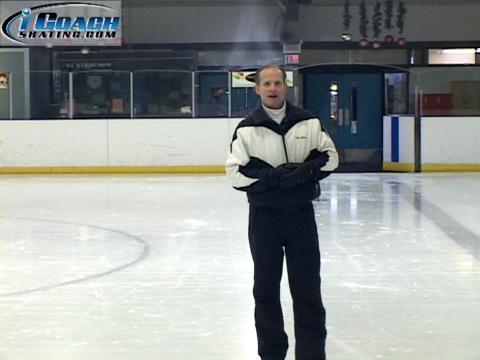
Nick Perna shares his thoughts and insights about learning and teaching backward crossovers (also called crosscuts). This is a follow-up to his earlier video on forward crossovers. Much like the earlier video, this is an in-depth video covering details which are generally glossed over by many coaches.
Nick begins the presentation by noting that most skaters typically develop the proper mechanics of keeping one foot on the ice at all times. This happens naturally over time but will happen faster if taught by the coach. Nick starts with pumping on two feet. He uses terms like “cut” and “blurb” and “crunch” from some of his earlier videos on power generation. Nick also has his skaters do back crossovers with both feet remaining on the ice. This allows him to make sure they’re pushing equally with each foot. At this stage he also makes sure the skater is getting full extension to a straight leg on every power stroke. Nick notes that most skaters learning quality back crossovers have a very difficult time hitting and holding the “undercut position” with both feet on the ice, while remaining on a circle. Great exercise!
To strengthen the pushes, Nick has the skaters isolate the pumps. First he has them pump repeatedly with one foot, then repeatedly with the other. Most skaters will not have any experience doing undercut pumping, but it’s a great drill to develop the power of the undercut. Nick says, “And when they can do that without scratching, without skidding, without scraping, then they have a good understanding of how the power has to be achieved in a crossover.”
Next, Nick addresses the controversial topic of reaching strongly into the circle. Nick does not like a big reach and he explains his reasons. Instead he emphasizes the outside foot pushing away from the inside foot and the inside foot coming down on a clean outside edge. [Editor’s note: More advanced skaters can effectively use a big reach, actually setting the inside skate down on an inside edge and pulling it under them and switching to the outside edge as the skate moves outward. This technique is very common in Russian pairs skating and appears to create very long and smooth movements. It also provides awareness of skate placement without having to immediately put weight on the foot, allowing for a more gradual and smooth transition. Some claim this method can generate more power, but there isn’t any direct evidence to prove it one way or the other. A key point is that most skaters initially working on back crossovers have no business making a big reach as they cannot yet control the positions allowing for correct application of that technique. -Trevor]
Nick also talks about the knee rhythm, which he calls a “down down motion.” He says, “So you get a little bit of a lilt, a little bit of a pulse motion to the knees as they cycle through.” He also talks about line and body angle that is important for aesthetics as well as power generation. He also discusses body posture and head position.
In terms of blade usage, Nick talks about “the stomping spot” on the blade. Many coaches mistakenly describe backward crossovers as being done on the front of the blade. They are not. (Nor are they done on the back of the blade.) Nick notes that the skater should remain in the stomping spot on the blade throughout the push or stroke. He also talks about the direction of the pushes. This is particularly important and challenging with the undercut leg.
Nick also discusses how the undercut blade comes off the ice and how it’s held as it gets replaced. Notice that Nick does not encourage pointing the toes. The argument that pointing the toes adds power is a myth without support. In reality it likely causes loss of power as it increases the odds of scraping the toe and catching the toe pick at the end of the undercut. Nick says, “I tell them to just keep the foot flexed, just like it would if it came of the ice naturally. And that foot is going to skate in the air. I call it air skating.”
At the end of the video, Nick addresses adding power by bending the knees more. More knee bend allows the power stroke to be longer or as Nick explains it as “length of the stride”, thus allowing more power generation.
Fantastic video.

Sorry, this content is for members only.Click here to get access.
Already a member? Login below… |

 Add to “My Favorites” (Beta testing)
Leave a Reply