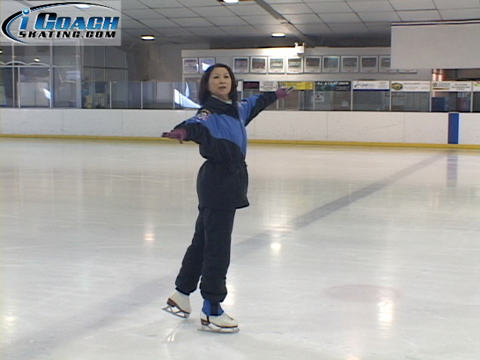
Figure Skating Jump Landings In Detail – Part 2 (Audrey Weisiger)

Audrey Weisiger offers some additional drills and explanations as she continues her discussion of jump landings.  She offers these valuable drills:
1. After a skater has landed and stretched into the final landing position, have them return to the ‘h-position.’
2. After a skater has landed and stretched into the final landing position, have them do a back outside bracket.  (Not a counter!)
3. After a skater has landed and stretched into the final landing position, have them hop up off the clean landing edge and then re-establish the strong landing position.

Head control is an important part of good jump landings.  Audrey wants the skater to turn the head toward the landing arm and hand and look “up into the audience.”  She concedes that alternate positions are necessary as part of choreography, but she feels strongly that during the skill development phase the head should be under complete control with the type of landing she describes here.

Audrey also explains the classic “landing in a frame” and why it’s so valuable.  She shows what she means and demonstrates the critical elbow position.  Here’s a gem every coach and skater should know about landings: “It doesn’t matter where your arms go if the core is under control.”  The majority of the deceleration forces for landing come from the free leg movement and core control.  This is easily observed on weak landings of skaters with “slow” leg checkout but “fast” arm checkout.

Audrey finishes with a quiz about landing positions.  The qualities of a good landing are:
1. Accuracy of foot placement to the edge,
2. Accuracy of the body,
3. Accuracy of balance point on the blade,
4. Maintaining flow, and
4. Beauty of the final sustained landing position.

Audrey says, “Think of the landings of your jumps as punctuation at the end of a sentence.”  This is another great video from Audrey.  Please leave her a comment below.


lock

Sorry, this content is for members only.

Click here to get access.


Already a member? Login below

Email
Password
 
Remember me (for 2 weeks)

Forgot Password


FavoriteLoadingAdd to “My Favorites” (Beta testing)

9 responses to “Figure Skating Jump Landings In Detail – Part 2 (Audrey Weisiger)”

  1. Audrey

    I liked this one! Thanks Trevor. Did you get to listen to SPARQ1 Nov 14 episode? It was such great info! Happy Thankgiving. Audrey

  2. C

    Wonderful. Thank you! I love the “act like your landing is the punctuation of a sentence.” I’ve notice that the landings are really what stands out. When watching a video, it isn’t the rotation that gets the audience going, it’s a perfect, confident landing complete with a grin or attitude. That gets them on their feet!

  3. Nancy

    Thanks Audrey! Great info, as usual! I like the drills for after the landing. I have a student who will not hold her landings and I know this will help her!

  4. Jackie

    Love it! Great information and exercises. Thank-you for sharing!!

  5. anick

    thank you Audrey for you excellent tips.. love the expression of the punctuation of the sentence as well!

  6. Nate

    Makes sense I had video’d myself doing an Axel on the harness and was wondering why my leg went back so fast, then noticed a second afterwards I had to step out cause I got whipped outside the circle. That being said the landing edge seemed correct so it must have been an upper body issue. Would have really liked to hear more ways to deal with opening up prematurely. Issue with me isn’t what to do with the leg on the landing, but holding a solid air position until it’s time to open up. My arms always open up way early but I jump high enough that it’s never really an issue because I can simply “fix it” in the air for single rotation jumps. However, since I’ve been working on the Axel it’s started to become a bother since the wasted energy/slowing down causes unterrotations even if you jump big on that jump (because it really destroys the jump and stalls you in the air, especially if you’re used to opening up in less than a rotation).

  7. Trevor

    Hey Nate – We really can’t diagnose problems with this “comment” format. But please keep in mind that the problems you discuss could be caused by all sorts of things, so just thinking of it as a landing issue may not be appropriate. Hopefully your coach is helping you get an accurate and correct take-off and you’re getting enough harness work to build the correct feeling of air position and landing. Good luck!

  8. Dorian V

    Always so helpful and generous Audrey! Thank you so very much 🙂

  9. Michelle

    We’re confused about #3) Accuracy of balance point on the blade. Doesn’t the first and/or second pick need to catch the ice first upon landing?

Leave a Reply to Audrey Cancel reply

Your email address will not be published. Required fields are marked *