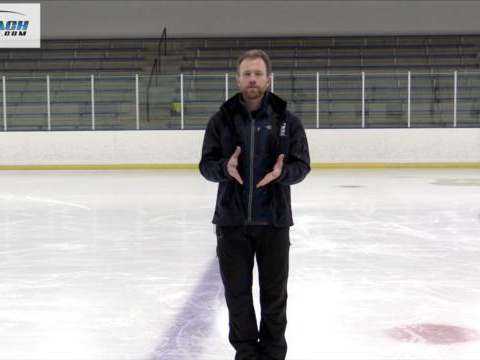
International coach and jump specialist Jeremy Allen continues his multi-part discussion of the axel jump. In Part 1 he discussed some important basics as well as how he teaches a waltz jump. In this video he goes into more detail and provides examples for things he talked about in Part 1, and he discusses more development drills as well.
For Jeremy, the goal with waltz jump is to learn how to step properly (for axel) and how to create momentum with the free leg. He says, “Even though we might not take that right leg (non-axel or swing leg) all the way through on an axel, a double axel, or a triple axel, we want to establish that sense of momentum. With a waltz jump we want to feel a swing, just really trying to get it to go out.” Jeremy doesn’t teach a strong h-to-h position movement pattern on waltz jump for axel development.
Next, Jeremy talks about the need to start the initial rotation on the ice as the free foot comes through, especially for axel. This is a balancing act, as skaters and coaches need to avoid rotating too little AND too much on the take-off. He demonstrates a reasonable approach with a deepening of the take-off edge just prior to the jump where the body gets somewhat sideways for lifting into the air.
For developing an axel, Jeremy uses the waltz jump backspin method as well as the once-around method. His skater provides a good demonstration of the once-around and a once-around with foot clap (to establish sense of where the feet are in the air). He also uses the one-foot waltz jump (similar to one-foot axels in Part 1 when developing the double axel) step to backspin to help skaters get used to the initial movement into the air position where the knees come together. It is also effective for introducing the idea of getting the skating foot to start turning on the ice (which they can eventually use with edge pressure to create more rotational energy).
Jeremy thinks of the axel as having two “snaps.” The first snap is the idea of snapping the knees together immediately after take-off kick through. The second snap happens when the axis foot pushes down and under into the standard jump air position. Rather than thinking of the axel snap as happening from forward to backward, Jeremy says, “In a very efficient axel, the snap is from backwards to forwards” and happens after the knees come together as the skater pushes the landing foot down and gets into the standard jump air position.
The ideal jump air position has the axis (landing) leg completely straight (“even hyper-extended”) with the foot flexed, and the non-axis leg crossed over and slightly bent (allowing ankle or foot contact). Because the axis leg is bent and the non-axis leg (take-off leg) is straight at the moment of take-off, many skaters struggle with reversing the knee bend. The straight take-off leg must bend and the bent axis leg must straighten as the skater lifts into the air position. It helps many skaters to think of purposefully bending the non-axis leg after take-off.

Sorry, this content is for members only.Click here to get access.
Already a member? Login below… |

 Add to “My Favorites” (Beta testing)
Leave a Reply to dorisk8s Cancel reply