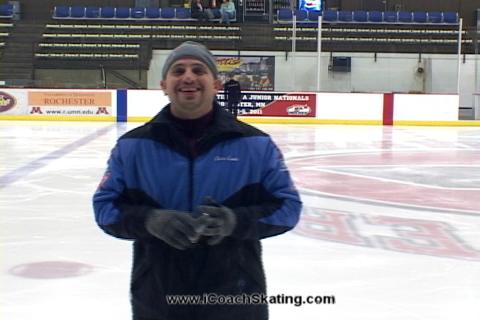
Chris Conte continues with Part 3 of his discussion of suggested improvements to basic skills instruction. In Part 1, Chris discussed marching, swizzles, rocking horses, and rotating swizzles with some discussion of arm positions and posture. In Part 2, Chris discussed basic spinning, internal hip rotation, and jump air position issues.
In this video, Chris addresses horizontal versus vertical arm movement in jumps and how to add correct arm movements to the drills he’s covered already. As Chris notes, “In good jumping, the arms don’t move horizontally. They move vertically. They appear to move horizontally in some cases due to the fact that the edge is turning, the hips are turning, the torso is turning, so the perception is the arms are moving in a horizontal manner. But they aren’t moving horizontally, because I’m rotating.”
Chris proceeds to explain proper arm movement for relaxed and efficient jumping. It’s amazing how many skaters cannot do this simple exercise correctly with correct timing and looseness. Chris notes that this is rhythmical which ultimately helps skaters develop proper timing. Chris then takes this stationary drill and adds it to the rotating swizzle to create a very powerful drill for learning proper jump rotation.
Chris takes a moment to discuss why we want to avoid horizontal movements for jumping. It generally destroys proper alignment, making recovery for a good landing nearly impossible for all but the best athletes. Chris makes a point of stating that he accepts a “natural amount” of shoulder pre-rotation in jumps at the higher levels, but as he notes, “At low level I teach not to do it, because they can’t control it yet.”
Chris then draws what the tornado looks like on the ice. He notes that this is an extremely efficient way of getting to a proper air position feeling as fast as possible. Later he explains that it also works very well to get into a tornado from an forward inside pivot, which is the more common way to teach rotation.
Chris goes on to discuss how a two foot spin is usually taught in learn-to-skate classes. It uses horizontal arm movements with the feet parallel and close together. Chris notes that this is very counterproductive to developing the feeling for proper jumping. The parallel feet alone is one of the causes of open hip air positions as skaters generally do not get exposure to internal hip rotation until much later (when it’s too late).
[Editor’s note: Most learn-to-skate programs use two foot spins to teach basic spinning and not jumping. In generating the most rotational energy for a spin, the arms do move horizontally. However, jumping is generally much harder than spinning, and Chris is suggesting that we teach the two foot spin in a manner that facilitates the skills that will be helpful for jumping.]
Chris finishes with yet another drill which alternates the forward half swizzle and then the backward half swizzle while rotating. He further suggests doing this with the head turned against the rotation (ala Sheila Thelen‘s “bite the coat drill” elsewhere at iCoachSkating.com). Chris references a YouTube video of a monkey doing this drill. I’ve included that video below. Enjoy!
Do you like the ideas the Chris is sharing? Please leave Chris a comment.

Sorry, this content is for members only.Click here to get access.
Already a member? Login below… |

 Add to “My Favorites” (Beta testing)
Leave a Reply to Hayley Lakeman Cancel reply