Improving Figure Skating: Learn To Skate – Part 6 (Chris Conte)

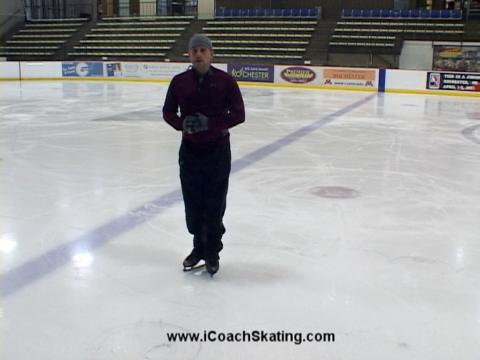
Chris Conte continues with Part 6 of his discussion of suggested improvements to basic skills instruction.  You can see the previous parts of this series here (Part 1, Part 2, Part 3, Part 4, and Part 5).  In this video, Chris teaches back hockey lunges, encourages alternate arm positions, and shows how to use lunges to create proper “crossunders” (crossovers) and cross strokes.

At the beginning of the video, Chris offers a summary of his pet peeves as they relate to teaching basic skating.  When you see how accurately Chris imitates a typical low level skater, it provides support for his ideas on curriculum change.

Notice Chris’s focus on creating edge pressure with a relaxed body and relaxed arms.  This is one of the primary characteristics of good skating and Chris believes it’s possible to start building this skill right from the beginning.  With a relaxed body that is properly aligned, it’s possible to have virtually any arm placement and still generate edge pressure and power.

When teaching back hockey lunges, Chris allows skaters to place their hands on their knee.  He wants the shoulders square (or neutral).  He briefly mentions that it’s hard to get the foot flexed behind.  This comment in passing is an understatement as the ability to keep the blade on the ice behind the skater is very difficult, but worth mastering.

Finally Chris shows how to use hockey lunges to create forward crossovers (he calls it crossunders) and cross strokes.  He notes, “Without the ability to lean the lower body and have the pressure and power [in hockey lunges], I’ll never have power in the stroking.  It doesn’t matter how much knee bending I do. I can push straight down into the floor and I’m not going to produce power away from the edge.”  This is an important concept that every skater and coach should understand thoroughly.  And Chris is right.  He says, “That’s just physics.”

[Editor’s note:  Note that Chris is not suggesting skaters should not bend their knees.  Most skating coaches put a very high emphasis on bending the knees as much as possible.  And rightly so.  Without knee bend, even having lower body lean will not create power.  And it is possible to create some power in basic stroking without any lower body lean by bending the knees strongly because it is possible to create a “push angle” when one knee is bent deeply and the other is straight or nearly straight.  This is the basis for traditional teaching methods.  However, as Chris notes, learning proper lower body lean and knee bend at the same time greatly speeds the learning process for generating power, especially on one foot.]

As stated in the summaries for the earlier videos in this series, Chris is not blaming anyone regarding the testing structure most skaters must pass through.  He’s simply saying that these are critical missing pieces that coaches must address outside the formal testing structure at this time.  This series of videos is to help coaches and low level skaters get the most out of their time on the ice and make the fastest progress possible.


lock

Sorry, this content is for members only.

Click here to get access.


Already a member? Login below

Email
Password
 
Remember me (for 2 weeks)

Forgot Password


FavoriteLoadingAdd to “My Favorites” (Beta testing)

12 responses to “Improving Figure Skating: Learn To Skate – Part 6 (Chris Conte)”

  1. Debi

    Chris you are a genius! I love what you contribute to our sport and I hope you keep coming up with these simple things to help with the more difficult one! Bravo!

  2. George

    : I often wonder why hockey skaters can zip past me no matter how hard I struggle to outskate them. Figure skates are wider and therefore have more friction (I think) but mainly it boils down to hockey skaters concentrating more on the power generated from their blades without worrying at all about the aesthetics of their skating. Figure skaters could probably learn a lot about efficient and powerful skating from hockey players. When I was young, my figure skating coach would always end our lesson by chasing me around the rink and told me to not worry about my form and just skate as fast as I could. He always caught me (LOL). I think Chris is talking about this issue also. Figure skating is traditionally a rather conservative and elitist sport and could probably use a less rigid way in how it’s taught (let’s all do a “monkey drop!”)

  3. JB

    A wine opener, I love it! You’re funny!! Great info. Thanks soooo much

  4. JB

    PS This has me thinking now of my little ones that once they have mastered swizzles-thats all they want to do and it was always a struggle to get them to glide on one foot. I would spend most of their lesson on stroking and then they would zip off on two feet swizzling! Of course now I realize thats what they’re comfortable on 2 feet. It totally makes sense what your saying. So I feel now I should turn the half swizzles into hockey lunges next. Would you say that would be the right time?

  5. Chris Conte

    You got it jb! That is the perfect time:) Opposite sides of a line like the traditional “slalom” drill perhaps? You just gave me a great idea for a game! 🙂 Comet! I’ll have to try it with a little one and film it. haha CC

  6. Elizabeth

    Hi Chris, As a late-blooming skater who started from no balance and sheer terror in my forties and who has struggled up to FS 3, I’m convinced about the value of what you suggest here but wonder how you would approach it with older adult skaters who begin with very little leg strength and who are typically very afraid of falling and hurting themselves… because what allows you to stay upright when your feet are not really underneath you is the power of push against the edge, which the beginning older adult typically does not have. Thanks in advance for any light you can shed on this.

  7. janet

    Thank you for touching on crossunders!! A video on crosscuts would be great…..So many have no concept or technique to create power from an underpush.

  8. Dorothy

    this is a great informative video!such great advice,thank you! and beautiful skating Chris!

  9. Grace

    More videos would be wonderful! I am so inspired!

  10. Peggy

    Chris get some DVDs going!

  11. Cheryl

    Makes total sense!! 🙂

  12. RussellBarnett

    Chris…..You remind me of my coach who taught me much of this many years ago!!! I am loving your basic skills videos and as I’m getting back to the sport and to teach beginning skaters….your skating philosophy is so amazing and right!! Thank you!! Now back to learning more!

Leave a Reply to Dorothy Cancel reply

Your email address will not be published. Required fields are marked *