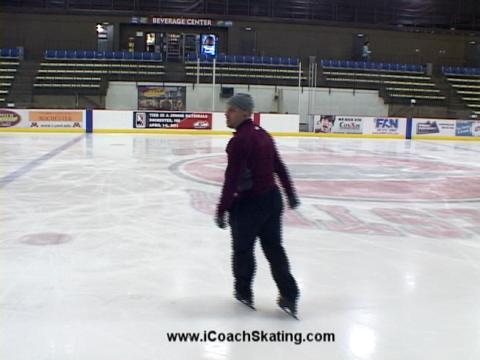
Improving Figure Skating: Learn To Skate – Part 7 (Chris Conte)

Chris Conte finishes his discussion of suggested improvements to basic skills instruction (Part 7).  You can see the previous parts of this series here (Part 1, Part 2, Part 3, Part 4, Part 5, and Part 6).  In this video, Chris discusses how hockey lunges can be used to create spins, jumps, and turns.

Notice how Chris uses the edge pressure of the hockey lunge to create a forward outside three turn.  In fact, by using edge pressure and the demonstrated leg movement, the check of the turn is almost automatic.  Many top coaches echo Chris’s argument that we should not be teaching strong upper body movements to create turns (and jumps and spins) with beginner skaters.  The hockey lunge into a three-turn solves this problem.

When discussing spins, Chris makes it clear he prefers same arm in front entries because it more closely mimics proper waltz jump or axel entry. Chris suggests introducing spins with a hockey lunge entry into a two foot tornado.

Notice that Chris focuses on edge pressure when developing spins, jumps, and turns.  This is the key to good skating and as Chris has demonstrated earlier in this series, it’s much easier for low level skaters to learn to create edge pressure using a hockey lunge than any other way.

When building an axel, Chris claims that the easiest way to create proper edge pressure is to initially train with hockey lunges.  Unfortunately, a very large number of coaches do not even recognize that the rotational energy for a good axel (or double axel or triple axel) is created by edge pressure.  (And hence they teach only the old-fashioned waltz-jump loop jump method.)  Chris gives a great explanation for the axel jump.  Notice the sideways take-off that is created by the edge pressure.  This detail is very important and often overlooked.

Chris uses a back hockey lunge to create jump landings.  This is a very valuable tip as a common teaching error in jump landings is to push the free foot straight back on landings.  It actually goes slightly around as demonstrated by the back hockey lunge.

Finally, Chris takes some time at the end of the video to explain common errors in hockey lunges so all skaters and coaches can use properly.  This was a great series from Chris.  Please leave a comment below.


lock

Sorry, this content is for members only.

Click here to get access.


Already a member? Login below

Email
Password
 
Remember me (for 2 weeks)

Forgot Password


FavoriteLoadingAdd to “My Favorites” (Beta testing)

16 responses to “Improving Figure Skating: Learn To Skate – Part 7 (Chris Conte)”

  1. Lauren

    great video series for learn to skate coaches. good work chris & trevor!

  2. Lisa

    More awesome information and enthusiasm!!! Thanks so much and happy hoildays;)!!!

  3. Amy

    Absolutely love this (and all the previous videos as well)~ thank you Chris!

  4. JB

    Wow, this makes it look so easy and such a natural progression from your hockey lunge – can’t wait to have students approach it this way. Thank you – good thing you do have these pet peeves. Great series! More please!!

  5. Autumn

    The hockey lunge is great and makes so much more sense in regards to the forward outside three turn! How could you translate that to make the forward inside and back inside and outside three turns just as smooth (as in initiated with edge pressure instead of upper body movement)?

  6. KA

    Great material in this series and well explained. Thank you!

  7. Pam

    Chris is a wealth of information! Thanks for sharing!

  8. alibabe

    fantastic. i work with learn to skate program students and these methods really work. especially with tense adults – the monkey drop is great to help them relax! brilliant!

  9. Hayley Lakeman

    DING DING DING! this is big. and completely fundamental. thank you and feel free to ‘go on for like three hours with this stuff’ 😉

  10. Annie

    Please keep going Chris, this information is great! Also feel free to do a video on correcting the pre-rotation you mention, I am in the correction phase with a few new students.

  11. Monika Janek

    I’m going to try this today on the ice! This is amazing. Thanks Chris! I’m afraid to try the tornado since I’m an adult but I’m going to go for it.

  12. Monique

    Truly novel and brilliant exercises! Thanks so much for sharing.

  13. junglejim

    Thanks Chris .. I’m going to try your methods at the rink and then discuss your videos and methods with my coach since has been trying to get me to develop deeper edges … Your videos have made things alot clearer and they are fun to watch…. rating of 5 – you deserve it …Thanks !!

  14. marjie

    Thanks Chris, I love and am fascinated by your presentations, am watching and “fave” listing all your videos. I have always craved a way to develop good jumping form systematically, in a way that one can master each successive step, and with a total understanding of what muscles are being used. Have learned, from experience, unfortunately, that repetition of bad form can destroy the parts of your body than don’t repair, such as cartilage, disks. Young kids can get away with that up to a point (since intervertebral disk material does get blood supply up to age 15 or so, as one of many examples of the healing advantages that kids have over older peeps), but older peeps really are better off putting a higher priority on “knowing what they are doing” then on just being the big hero and “going for it”, as far as I can tell. Anyway, I have a question about a thing you said in this series, I forget which exact video. You said that rotating in the forward inside edge body alignment (in contrast with the back outside edge body alignment that would happen in a back spin) puts the sternum over the ASIS, which would be ideal, and in contrast to the BO alignment which has the skating hip a little more “out”. I am now dying to know how, in terms of bony landmarks, you would describe the body alignment in the other three edge positions (BO, BI, FO). My understanding, until now, had always been like this : whatever the edge you are skating on, or even the (relative) flat you are spinning on, is, you basically want to have free lung over skating femur head. What will distinguish one edge from another is not any big difference in this trunk alignment, but rather where you are pressing into your blade… forward edges press through the heel, say below ankle knob, inside or outside, and back edges press through the ball of the foot, behind big toe or pinky toe. (I mean that was the basic rule, as I understood it, for running edge, and then for turns, jump entries, spins, other trauma, you rock momentarily more forward or back on the blade depending, or more center if twizzle.) As far as trunk bony landmark line up goes, my “free lung over sk8 femur head” still seems to me to equal your “sternum over ASIS”, but now I am wondering how, as you suggest, trunk alignment would differ between FI, BO, BI, FO. I do see in your circle lunge exercises for developing strong FO and BO, there is that “hip out” thing – is not “out” so far that you have torso leaning away from circle, but IS out in that you have lean from blade to hip, and vertical from hip to shoulder… and in a back spin there would be a bit of this but not nearly so much as in a deep running edge… and in the inside edge counterpart to this you would have skating hip “in”…so maybe this is all that you mean ? But as I say, anything you can add re edge positions and trunk alignment bone by bone, is much appreciated. While I am trying to shore up my core to the point where I might be able to skate again, even with damaged lumbar disks (may not ever happen), I am working on edge positions on spinner and edge trainer, among a lot of other Pilates type stuff… so I want to make sure my understanding of edge positions is the best it can be. thanks !! I just love what you are doing !

  15. babbette

    So, I’m an adult learner. My 3 turns have always been of the forced rotation type with a hip fling. Today, I did your hockey lunge entry drill and I realized, oh, it’s forcing me to keep my free hip back. Went into straight 3 turn practice from standing then moving , and once I had the idea of the free hip back in my head, I could do three turns in any style: Freestyle, figures, dance. Tell me where you want my freeleg, and where do you want my free foot to point and I could do it. All in five minutes. I couldn’t feel that free hip position until I did this exercise. Thanks!

  16. GinaBianco

    Mic drop moment. Thanks, Chris.

Leave a Reply to marjie Cancel reply

Your email address will not be published. Required fields are marked *