Play the top video first to see the jump being analyzed.

Sorry, this content is for members only.Click here to get access.
Already a member? Login below… |

 Add to “My Favorites” (Beta testing)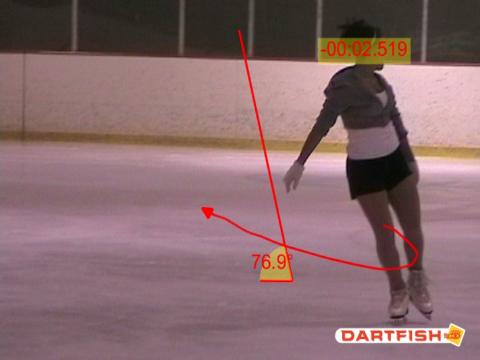
Play the top video first to see the jump being analyzed.
Sorry, this content is for members only.Click here to get access.
Already a member? Login below… |
Add to “My Favorites” (Beta testing)Awesome analysis! How many versions of dartfish are out there now, and how often do they update? I think we have an older version. Thanks again!
i totally agree with Marcia!
Very educational!!! Thank you 🙂
Very informative-Thank you yet again!
Great! Amazing!
This explains why the feeling of stepping up into the air for the jump is a good feeling!
Thank you for your analysis, Chris. It is amazing how such a small amount of time can make such a big difference in the success of a jump.
Yup, I’m a skater who has trouble getting my legs to pull in tight while jumping on ice. But off ice for some reason, I don’t have this trouble. Why?
Super – What a great tool!
Great info and analysis.
I like the superposition of both double axels.
Very informative-Thank you!
I watched this video as a skater and as a coach. I had been under-rotating my double axel, but i landed it right after i watched this video!! Thanks so much!
Thank you so much!! This is great!!
The first skater pre-rotates her torso and has it (her torso) spining before she takes off, and too much out of control, which is causing a great lean to the outside of the circle (to the left).
Having her feel like she’ll jump UP first and then rotate will really help the lower body rotate underneath her and that rotation of hips and legs will then “take” the upper body and have it aligned with her right landing leg for the axis of “back spin” position in the air.
Sometimes *feeling like there will be a slight pause with the upper body on the way up; *Holding her head and her eye sight to a specific point ahead (or a little to the right) of her during the take off and way up; *Having her chest face the right knee for the ‘h’ position, are things that can really help her feel that her legs will do the jump and not the upper body, and get that feeling of going UP first and then rotating, beginning the rotation with the lower body and not the upper.
Thanks for all the information that’s out here at icoachskating. It`s really great!
Plus (more precisely in this case) she must jump towards the direction of the TANGENT of the circle initiated in the back outside edge on the preparation. That`s where the jump must go. It must take off towards the direction of the tangent approximately. Or even more to the right. That`s where the axis of rotation will be.
She should be jumping with her chest facing about 90o degrees to her right, in relation to the direction that her jump is currently taking.
This is, more precisely, what`s happening, she`s sending her parabola to her left by jumping towards almost the direction of the center of the ice ..
She would need to have her chest, and her body, the jump itself taking off to the direction of the long side wall.
The thing is, even when the skater thinks about going straight forward in an axel (single, double or triple…) it does curve a little bit. Having the intention of really forcing that curve and jumping towards the direction of that tracing would definitely cause a lean to the outside of the circle. Cause they`d be jumping (taking off) to the inside of the circle when they`re forward and landing backwards leaning to the outside.
So, on a precise axel, (sing, double, triple…) the tracing of the foot after the mohawk does curve, the body does not. It goes straight forward.
Looks like once she`s able to take off towards the right direction, it it will be a great double axel!
Hope that helps!
Leave a Reply to Nikki Cancel reply