Introduction to Beginner Axel – Part 2 (Nick Perna)

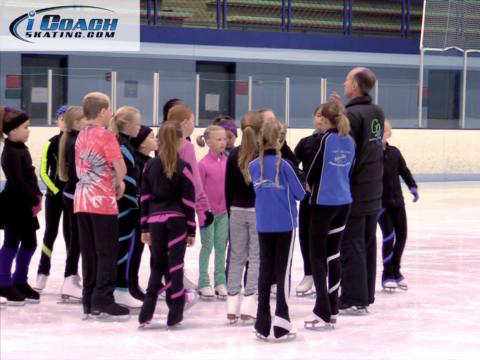
International coach and jump specialist Nick Perna continues an axel development class for young skaters at a camp, introducing the early concepts as they relate to waltz jump. A significant percentage of this class is not really ready to work on the axel, but as Nick demonstrates it’s never too soon to teach important concepts that will make axel development dramatically easier down the road. In Part 1, Nick shared important waltz jump tips such as getting under the jump, stepping onto a controlled forward take-off edge while “kicking the butt” with the free shoulder back, and narrow arm movements.

In this video, Nick begins by talking about the desired arm swing in more detail. He says, “I don’t teach the arms bent. I find that when they bend they sometimes go into jug handles or coffee mug handles.” Instead Nick teaches the arms relatively straight, going from touching in front to behind as narrow as possible. To keep the hands narrow and close while in back he thinks of clapping the hands behind the back.

Again Nick emphasizes the importance of keeping “the chest up like someone is reading something on your shirt.” He also reminds the class of keeping the non-axis shoulder back, the head up, and the free leg bent to “kick the butt.” For the next phase he says, “We want to bring our hips under before we bring our leg through.” He describes and demonstrates this concept in detail. To help the class understand, he compares the motion to swinging on a swing set. Additionally, when the leg comes through Nick wants the leg bent with the free foot flexed. He says, “You’ll get a higher jump if you flex the foot as it comes through.”

When troubleshooting waltz jumps for the class, he talks about head anchoring with a number of skaters, highlighting just how important it is to notice and correct at this level. He describes this as “it just wants to stay put.” He encourages these skaters not to “yank the head around.” He continues to monitor the class while offering individual feedback.


lock

Sorry, this content is for members only.

Click here to get access.


Already a member? Login below

Email
Password
 
Remember me (for 2 weeks)

Forgot Password


FavoriteLoadingRemove from My Favorites

5 responses to “Introduction to Beginner Axel – Part 2 (Nick Perna)”

  1. MarjorieWengert

    This is a really great video. I do have a question about the position of his body as he is demonstrating the leg swing through moment with the hips going first. He appears to be leaning back – away from the jump. Was this to emphasize the hips through first motion – or is he saying the body should be actually in this backward “C” shape? Thanks!

  2. annashapiro

    I’m also curious about Marjorie’s question. It seems that the backward lean would be the result of pressing the skating foot in front (per your other tutorials) and not something you would want the skater to do artificially (i.e. just lean back as the skating foot passes through). I don’t think skaters learning waltz jumps would be able to generate enough edge pressure to press the skating foot in front (unless I don’t understand and would happily stand corrected!) and if that’s the case then what’s the best way to teach them this motion while they develop the skating skills required for generating strong edge pressure? They’re probably not capable of correctly doing a skidded three turn at this stage either so what should a coach focus on? I can make some educated guesses but curious how experienced coaches handle this situation!

  3. Nick

    Thank you for the questions! To answer, I will say that, yes, the leaning back of the body on an axel is primarily a result of the “active edge” being pushed out in front of the body…but…I DO emphasize this leaning back motion to beginning students learning waltz jumps as a way to get them to understand that the HIPS must move underneath and forward so they can achieve the required upward trajectory of a good jump. In most cases, the skater will not actually lean back excessively as they move their pelvis forward, but will, in fact, achieve the desired “swing set” motion I am looking for. I hope this helps answer your questions.

  4. annashapiro

    Thank you for clarifying, Nick! This makes sense, and a nuance that I’ll have to think about some more. 🙂

  5. MarjorieWengert

    Thank you so much for the clarification!

Leave a Reply to Nick Cancel reply

Your email address will not be published. Required fields are marked *