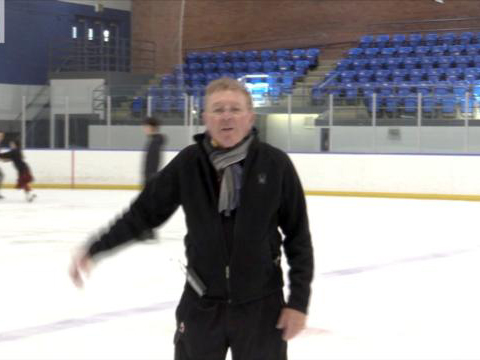
World and Olympic coach Doug Leigh shares thoughts and exercises about the loop jump. He begins by discussing jump landings in general, showing an exercise at the wall that simulates air position and checking the rotation at landing. He begins this by facing the wall and standing on the toe pick of the non-axis skate in the flox air position. By turning 90 degrees in the direction of rotation he simulates the final movement to landing, lowering onto the axis foot which is then turned parallel to the wall. The shoulders remain facing the wall as the feet finish the last 90 degrees of the rotation. Doug says, “I’m trying to plan the exit before I take off.” During the last 90 degrees, Doug also lowers the non-axis arm so the hand is “in line with the hip bone” and he keeps the axis arm back and on the wall.
For learning a new jump, Doug says “I’m going to take the speed and kill it, because speed makes you in a hurry and you don’t trust yourself.” For the loop entrance, he likes a forward mohawk because you can accelerate during the step and get quickly to an aligned position with balance, direction, and calm. Next, Doug focuses on creating a “sweeping feeling” with the axis arm, typically with a back outside three-turn. He has the skater perform 2 of these back outside three-turns and then a loop-loop-loop combination. This exercise or sequence of movements is great for rehearsing the desired movements in a calm and controlled manner. Doug then shows how these concepts also apply to flip and toe loop.

Sorry, this content is for members only.Click here to get access.
Already a member? Login below… |

 Add to “My Favorites” (Beta testing)
Leave a Reply to TomZakrajsek Cancel reply