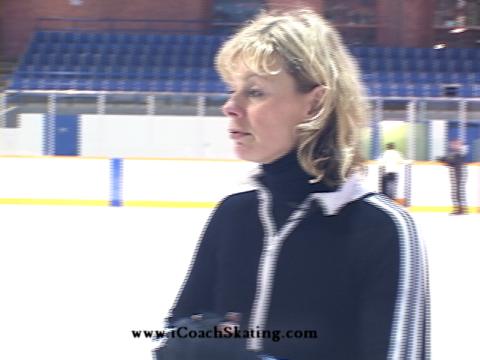
Figure Skating Jump Landings (Michelle Leigh)

Olympic coach Michelle Leigh explains the details of a good landing.  At initial impact with the ice, Michelle wants the skater’s shoulders in line with the skating foot and landing edge.  This requires the skater to twist the shoulders to the landing side in the air prior to impact.  This shoulder position allows the skater to decelerate the shoulder rotation in a controlled manner after impact.  One of the biggest myths in figure skating is that at landing impact the shoulders are square to the landing foot and to the direction of flow.  Video proves that it is not.  It would be impossible to land a triple with such a position because the shoulder deceleration forces would have to be extreme.  Michelle’s desired positioning is supported by video analysis.

After impact, Michelle wants the left arm to move forward with the free leg before being pressed back.  The free leg initially moves forward to help slow rotation and then moves back and around the skater.  Note that Michelle does not want the skater to lift the free knee on landing but prefers to have the skater learn to push the free foot and leg forward.  She begins teaching this landing method on the single loop jump.

As a final landing position, Michelle wants the skater to lift the free hip, head to the landing side, the landing arm level and into the landing circle, and the free arm to “show off as much as possible.”  Michelle wants “a really big position to enhance your Grade of Execution (GOE).”


lock

Sorry, this content is for members only.

Click here to get access.


Already a member? Login below

Email
Password
 
Remember me (for 2 weeks)

Forgot Password


FavoriteLoadingAdd to “My Favorites” (Beta testing)

4 responses to “Figure Skating Jump Landings (Michelle Leigh)”

  1. Lauren

    Why is it better to check out of a jump with your free leg “forward, out, and around” instead of “up and out” (the “h” position)?

  2. JC

    Was hoping the above comment would be addressed and answered? As I am also curious to know.

  3. Trevor

    In response to lauren and jc – Video shows that most skaters landing double axel and triple jumps for the first time will naturally land the way that Michelle describes. When a skater does not have excess flight time to begin the check-out in the air, the body automatically shoots the foot straight forward (regardless of what their coach teaches) and the body also pitches forward to help slow the rotation. Using Michelle’s method at lower levels allows the skater to experience this feeling much earlier in their skating career and learn to get the leg back from this position. Many skaters that could land double axel for the first time but don’t know how to move the free foot back after it shoots forward often struggle for some time with this. They typically land repeatedly in back shoot-the-ducks and then sit down. Is Michelle’s method better? I don’t know but I think it’s worth thinking about in terms of optimized progress as skaters will have to deal with it at some point.

  4. Bryan Smith, Chicago

    This video, the questions, and Trevor’s response, remind me of why I love icoach skating. My question: so does this apply to single axel? When I was first learning it (I’m an adult skater) I was doing what Trevor says — landing in back shoot-the-ducks position. So should I be aspiring to the position Michelle describes above?

Leave a Reply to Bryan Smith, Chicago Cancel reply

Your email address will not be published. Required fields are marked *