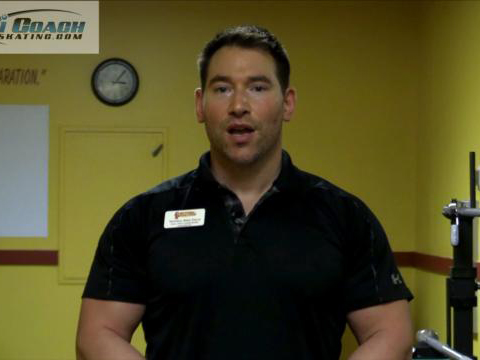
More Off-Ice Jump Power Training (Matthew Blair Davis)

Figure skating strength and conditioning expert Matthew Blair Davis continues his series on jump power training. In the first video of the series, he demonstrated a fancy setup for gathering detailed data for monitoring a skater’s progress and providing motivation. In this video, Matthew shares a low tech off-ice drill to help develop jumping power.

All that’s needed for this drill is a 12 inch box or similar ledge, a stopwatch, and a weighted vest, in this case a 10 pound vest. The skater starts with one foot up on the box and the other on the floor with the opposite arm forward (opposite to leg that’s up). The skater then tries to jump very high as many times as possible in 20 seconds, switching legs throughout. The goal is to get 20 repetitions in 20 seconds, spending as little time as possible on the ground/box. If the skater get’s less than 20 reps, they are jumping a little too high. If they get more than 20, they need to jump higher.

This kind of power training or plyometric training works best when done in short (20 seconds) bursts at very high intensity. Matthew explains why the amount of time is important, as it keeps the skater’s body in the “phosphocreatine-based system that’s your power system.” Matthew also recommends at least a 3 to 1 work to rest ratio. So 20 seconds of the drill, followed by 60 seconds of rest, repeated by 20 seconds of the drill (just 2 sets!).

Matthew spends some time talking about the weighted vest. It’s not that expensive, and it’s a great off-ice training tool for skaters. Notice the trade-offs in choosing one for skaters. To finish the video, Matthew notes that he helped a skater with a consistent double axel to increase vertical jump by 7 inches in just 10 months. That additional jump height helped the skater get the triple axel.


lock

Sorry, this content is for members only.

Click here to get access.


Already a member? Login below

Email
Password
 
Remember me (for 2 weeks)

Forgot Password


FavoriteLoadingAdd to “My Favorites” (Beta testing)

7 responses to “More Off-Ice Jump Power Training (Matthew Blair Davis)”

  1. ErikaDeCarlo

    So, a 1 to 3 work to rest ratio, not a 3 to 1 ratio. That would be 20 sec of work followed by 60 sec of rest.

    1. Trevor

      Yes Erika, I think that’s correct.

  2. DivyaRao

    Where can we get this vest please?
    Thank you!

  3. Trevor

    Weighted vests are a very common training tool and are for sale in local sports supply stores and online. A basic search shows there are many styles and brands sold on Amazon and some are also available at common retailers like Walmart.

  4. DivyaRao

    Thank you, Trevor! I do see some coaches using weighted vests for on ice training. Is that advisable and can the same kind be used for on ice?

  5. Trevor

    DivyaRao, there are a very small minority of coaches who use weighted vests for on-ice training, and the vast majority of those coaches only use it for conditioning. In general, it is believed that wearing a weighted vest during specific skill work is not a good idea, regardless of the sport. I would say that if a weighted vest worked really well for on-ice conditioning, everyone would already be using them. Same with parachute training and other conditioning training aids. Power on the ice is created by developing strength and power in controlled off-ice environments and developing rock-solid on-ice skill technique. Others can comment, but I personally would not recommend using a weighted vest (or ankle weights) on the ice as a general training method. The increased injury risk alone is enough reason to avoid it.

  6. DivyaRao

    Thank you, Trevor! I always wondered about the point of injury in wearing these vests and jumping double/triple jumps and your point on it has sealed the deal for me in terms of using them on-ice. I completely agree they have been very beneficial for us off the ice though!

Leave a Reply to Trevor Cancel reply

Your email address will not be published. Required fields are marked *