Off-Ice Jumps – Part 1: Basics and Axel (Michelle Leigh)

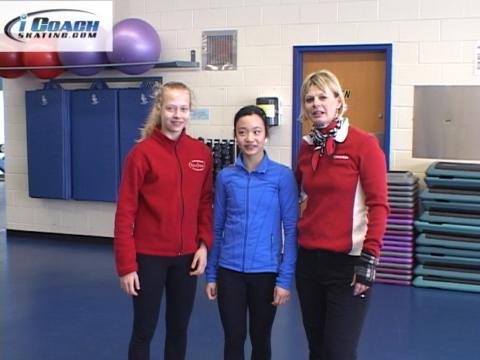
World and Olympic coach Michelle Leigh begins a multi-part series on off-ice jumping.  A large percentage of elite skaters use off-ice jumps as part of their regular training and warm-up.  And top coaches like Michelle often have very valuable insights about how to do it safely and effectively.

As with other off-ice jump videos at iCoachSkating (i.e. Nick Perna, Kori Ade, Tom Hickey, Grace Lee), Michelle starts with basic rotations off 2 feet.  First comes half-turns in one direction, then repeating half turns in both directions.  That is followed by full turns in one direction and repeated full turns in both directions.  For multiple revolution jumps off two feet, the two demonstrators offer alternate methods of starting from a standstill or starting with some initial steps to create rotation.

The video ends with some demonstrations of off-ice double axels.  Michelle explains her preferred entrance for off-ice double axels that uses steps and hops to create some initial rotation.

Check out all the videos in this series: Part 1, Part 2, Part 3, Part 4, Part 5, and Part 6.


lock

Sorry, this content is for members only.

Click here to get access.


Already a member? Login below

Email
Password
 
Remember me (for 2 weeks)

Forgot Password


FavoriteLoadingAdd to “My Favorites” (Beta testing)

2 responses to “Off-Ice Jumps – Part 1: Basics and Axel (Michelle Leigh)”

  1. VasilikiKantere

    Hi,
    I was wondering, for an off-ice double axel and off-ice triple jumps, how many rotations do we need to achieve (this is for agirl/woman)? Would 2 full rotations, (e.g. this means landing forward for an off-ice axel, or shaving 2 full rotations for a an off-ice loop) be enough for double axel and triple jumps on the ice?
    Should one focus more on jumping higher off-ce?

    Thank you.

  2. Trevor

    In response to your question, the goal with off-ice jumps is ideally to landing them with the same amount of rotation needed to land them on the ice. This typically means landing backward or at 90 degrees to the flight path and then turning or hopping to backward. Although coaches’ opinions differ, I think that skaters should primarily focus on proper technique both on and off the ice. Jumping high is part of proper technique, but jump height should not prioritized at the expense of proper jump technique or the need to get to an efficient rotational position quickly. In my experience, not all skaters benefit from off-ice jump training, and not all coaches (even elite ones) use it as a foundational part of their training.

Leave a Reply to Trevor Cancel reply

Your email address will not be published. Required fields are marked *