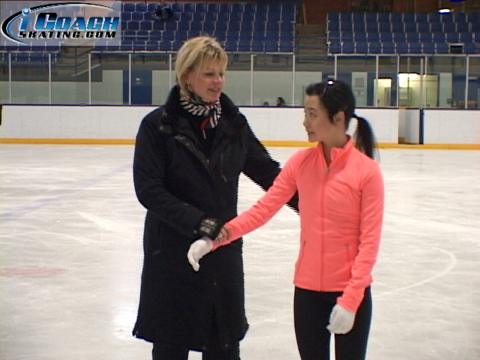
Olympic coach Michelle Leigh discusses details of the salchow, particularly as it relates to the triple salchow for the demonstrating skater. Michelle discusses the issues the demonstrator is working through and she shows the drills and walk-throughs she uses to address them. Notice the “cross-cut” salchow entry as a way to keep the free leg and hip in a good position prior to the jump. Also, Michelle makes a point of having the skater reach forward with the skating arm as the free leg goes back, instead of just trying to keep it still. She shows where the hands and arms move to for balance and power generation, “so they can move together and up into the air position.” Michelle wands the wrists to “connect” so the skater knows exactly where the arms and hands are.
Notice the “air position” portion of the walk-through where Michelle stresses the “flex” of the landing foot (rather than pointing the toe). Also see the shoulders twisted rotationally toward the landing side. The landing portion of the walk-through is novel and mimics what actually happens on landings, although very few coaches teach it this way.
Michelle mentions some things the demonstrator already does really well such as the free leg position and movement as she steps up into the jump and the proper “feel for getting her hips under on the take-off.” Notice when Michelle said these words she also leaned back as the take-off should have a slight lean backward where the hips are driving up into the jump. For working the landing, Michelle uses the double loop with very little speed and a variety of arm positions (see video). In the video, you can really see the skater’s alignment “into the circle” during the landing drill. Michelle likes this drill as it keeps things simple and builds focus on looking into the landing circle.
Michelle says, “It’s never too early to teach our skaters to flex the rotation foot.” She explains that flexing this foot (landing foot) in the air helps straighten the landing leg quickly and efficiently in the air. She shows the air position and landing drills in more detail near the end of the video. When the skater makes impact with the ice, Michelle teaches the free skate pulls back (or is forced back by the physical forces of the jump) and then shoots forward and then back into the landing position. She does not encourage her skaters to “lift up and out” on landings as it often sets the skater’s body back too far and gets skaters used to opening from the jump too early while learning it. When the free skate initially goes back on landing and then shoots forward, it’s critical that the knees stay tight. The words Michelle uses are “step back, and forward, out and around.”

Sorry, this content is for members only.Click here to get access.
Already a member? Login below… |

 Remove from My Favorites
Leave a Reply to Trevor Cancel reply