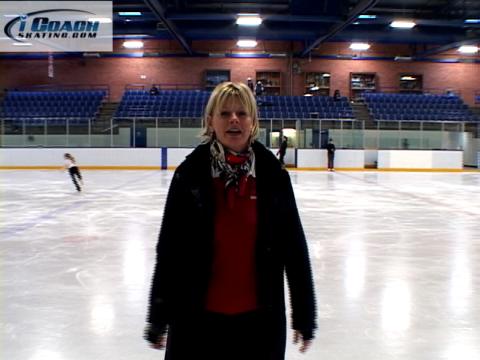
World and Olympic coach Michelle Leigh explains one of the most important concepts related to doing good salchows. To create the rotational energy and jump height necessary to do triples and quads, skaters must generate large rotational and vertical forces prior to take-off. And Michelle explains that this is best accomplished by dropping the free leg way down and way to the inside along with the entire body as the skater turns from backward to forward in the take-off movement.
As Michelle describes it, there’s a moment where the skater is up and balanced over the skating foot. But as the free leg comes forward and to the side, the skater should feel their entire body well inside the circle. She says, “Sometimes we’re a little too afraid to feel this, but we need this momentum inside in order to create that rotational energy to push up.” She notes that being completely balanced doesn’t work because it’s not possible to generate the energy that way. She says, “We have to allow ourselves to be wide” and well inside the circle, but strong enough to be straight up at the moment of take-off.
Michelle is a big fan of working on salchows from a cross-cut (or undercut part of a cross-over as it’s called in the USA). She likes the low foot position with the free leg well back when using this entry. She says, “Sometimes when we do salchows the entry causes mistakes” where the free leg is too high or comes around to much. Using the cross-cut entry, the skater does a cross-cut on a shallow circle, then stands up over the skate on a straight or only slightly bent knee, and then drops into the circle to create the necessary rotational energy. She wants the skater to really stretch into the circle and keep the free leg low, even just touching the ice (without any weight on it). Michelle says, “A common mistake on a salchow is to use too small a free leg and you don’t have enough momentum. Instead of the free leg coming close, [it should go] out wide.”
Notice that throughout the video Michelle talks about being inside the circle to create the energy to push up. This is similar to this video where a loop jump is described as having a pole-vault-like take-off movement. Thus, this method of “unbalancing” the body during the hook creates powerful forces that generate rotational energy AND jump height. Once a skater has mastered this wide position and can control it, adding extra entry speed gives additional jump height without making any other changes.

Sorry, this content is for members only.Click here to get access.
Already a member? Login below… |

 Add to “My Favorites” (Beta testing)
Leave a Reply to ChengqunSun232 Cancel reply