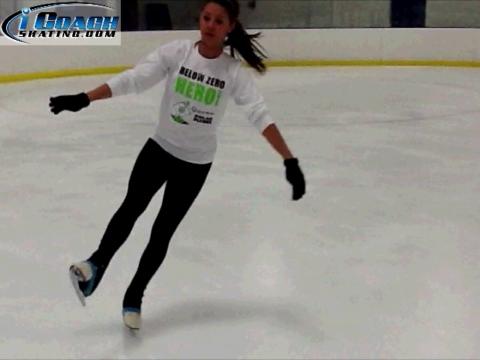
Axel Jump In Slow Motion Tips (Trevor Laak)

Trevor Laak analyzes a double axel as a way to identify key aspects for single axel instruction.  You can see a full video of the jump being analyzed below in real time and slow motion on Trevor’s axel checklist page.  (In the video below, Trevor mentions the video clip can be found on this page.  But it can only be seen at the link above.)

In this video Trevor is sharing key points about what he looks for in the development of the axel to ensure that it is based on sound principles.  Primarily, Trevor wants the axel’s rotational energy created by a strong and controlled entry edge.  He wants the edge to deepen without rotational or “around” movement of the arms, shoulders, or free leg.  Trevor says, “The quality of the axel comes from the quality of the [take-off] edge on the ice.”

Trevor addresses the fact that most presentations on axel focus on methods or techniques and have little or no emphasis on fundamental principles.  Recognizing that the axel needs a strong take-off edge that deepens as a result of edge pressure gives both coach and skater an advantage in developing a great jump.

This was supposed to be a short video but Trevor discusses a lot of detail from entrance edge details to air-position and landing explanations as well.

Topics covered include:
1. “Push” versus “step” into axel
2. Take-off edge deepening
3. Free foot position and movement
4. Free leg position and movement (not straight!!!)
5. Shoulder position and movement (square versus closed)
6. Narrow arms versus wide arms
7. Free foot on target line at take-off (and does not cut across)
8. Sideways karate kick take-off position
9. Timing of skating knee extension
10. Excessive body movement during the jump
11. Hands and head position at moment of take-off
12. Turn-over into air position
13. Air position
14. Wound up air position at landing impact
15. Free leg movement on landing
16. Upper body deceleration for landing control
17. Landing position

Trevor notes that proper waltz jump instruction is critical for creating good axels.  In particular he addresses the problem of leaning forward in a near-spiral position when skaters first learn the waltz jump take-off edge position.

Please leave a comment.


lock

Sorry, this content is for members only.

Click here to get access.


Already a member? Login below

Email
Password
 
Remember me (for 2 weeks)

Forgot Password


FavoriteLoadingAdd to “My Favorites” (Beta testing)

14 responses to “Axel Jump In Slow Motion Tips (Trevor Laak)”

  1. Debi

    Thanks so much Trevor for all you do! I love these step by step analysis!

  2. Lisa

    To echo Debi’s sentiments, I want to thank you for your amazing dedication to this fabulous website and all the fantastic knowledge-sharing you do to make our beloved sport better:)!!!

  3. Helen McGrew

    Thank you so much for sharing this video. It is exceptional and I am looking forward to the drills for edge pressure! I have been using the twist drill from Michelle and have already seen results!

  4. Amy

    this information is so detailed, thank you!

  5. Trevor

    Thank you Debi, Lisa, Helen and Amy! I really appreciate the positive feedback. This project is obviously a labor of love for me so it’s extra special if it has an impact.

  6. lsussman

    Thanks so much Trevor! This was a really helpful video, and I would love to see additional videos that discuss drills dealing with edge pressure, as you mention at the end.

  7. NakedApe

    As a clockwise spinner/jumper, I find there is a dearth of information for me as it adds additional level of difficulty for me to translate every instruction into its mirror image. I sure wish that there were some videos for us clockwise spinners. I understand that about 10-15% of people spin to the right, including Carolina Kostner and Ashley Wagner (two of my favourite skaters). Perhaps this is something you might consider, Trevor. Love your new, better organized, website.

  8. Trevor

    Hey NakedApe, thanks for the feedback. You’re right, with only 10-15% of skaters spinning and jumping the other way, almost nobody takes the time to create instructions just for them in standard training materials. But it’s one of the things on my to-do list here at iCoachSkating.com. You should see some new materials just for you in the not too distant future. Thanks.

  9. Sean

    To NakedApe, as much as I’d love a “flip horizontal” button on the videos, you can do what I currently do to convert counterclockwise to clockwise: use a small mirror. Primitive but effective 🙂

    BTW, great video.

  10. David

    Alot of good info on this analysis .
    One thing that isn’t mentioned is the lean into the curve from her left hip to left foot on the takeoff. Is that a result of pressing on the edge or is she taught to lean the hip in to help create the curve for the edge ? You can’t create a curve while keeping you’r balance without a lean.
    Another thing is that when a skater presses and moves their weight onto the rocker of the blade that is on an angle the radius of the edge will decrease causing the foot to turn and thus the rotation of the jump is started. That is the use of the rocker on a blade for all edge jumps . Why is this not mentioned ?

  11. Trevor

    In reply to David’s comment and questions, I’d like to clarify what I think happens. You do not need a significant lean inside the take-off edge on an axel and in fact we do not want one. An axel entry edge is not an equilibrium condition but rather a dynamic condition where the positions and edges cannot be held indefinitely. Yes, there is some lean between the foot and the hip. But the desired method of creating edge pressure and rotational energy is pressing the skating foot out in front of the skater, and turning it. This is typically not referred to as “lean” in skating. Pressing the skating foot forward allows the skater to create astonishing edge forces without leaning. I’ll create a video about this soon.
    In regards to the comment about the use of the rocker, the ability to turn a skate blade to initiate rotation for an edge jump does not depend on where on the blade the skater puts their weight. I’ll try to explain. Most skaters that double and triple axel with a skid do so in the center of their blades, merely rocking to the toe pick at the very moment of takeoff after the blade has already stopped moving on the ice (and stopped generating rotational forces). Even on clean edge double and triple axel take-offs, high speed video suggests skaters do not rock forward significantly on their blades until the absolute end of the take-off edge. It is easy to demonstrate that we can make an edge deeper and turn our skate without rocking forward on the blade. Just play around on the back of your blades for a while and try turning. You don’t have to keep going straight just because you are on the back of your blade.
    I’ve also had the good fortune of seeing hockey players in hockey skates doing axels. They would take off using a skid, and their balance was so good they could jump from the center of the hockey blade. Naturally, it’s much more forgiving to finish the take-off by coming off a toe pick. But the hockey axel example makes it clear that we do not need to rock forward on the blade at all for axel.
    In general, I don’t agree that rocking on the blade is what causes the rotation of the jump to start, for any of the edge jumps. I know this is what we’ve been told for decades by elite old-school coaches at seminar after seminar. But it’s easy to disprove by asking skaters to stay in the middle of their blades on salchow and loop take-offs. Sure, they have to rock forward on the blade in the split second before pivoting to the forward take-off, but the primary rotational forces are generated much earlier than that on the take-off edge, which is usually performed further back on the blade.
    This is all really difficult to explain with just words, so I will attempt to create a video about it shortly. Nick Perna’s bread drill alone completely debunks the idea that the rotation for an edge jump is created by rocking on the blade. Nick shows exactly how to increase edge pressure and curve radius without changing where the weight is on the blade, front to back. I hope all this makes sense. I’d love some others to jump in on this discussion.

  12. Diane Rudnick

    Great video and analogy – I am one of those people (old school) who swing their free leg straight-out and around on my waltz jump … and consequentially on all my jumps I am too open and struggle to have correct rotation position – I am just getting ready to try and start working on an Axel .. couldn’t get it as a child.. going for it as an 54 year old. Would love to see more tips for starting this jump as an adult! Thanks.

  13. JanetWright

    Thank you for this great video. I am also one of the old school who learned the Waltz Jump swinging the leg straight through which has resulted in terrible problems for me trying to hit the rotational position. I think the karate kick might slightly help me from trying it on the floor. I am 68 (please don’t laugh) but have struggled to do a correct Axel all my adult years, never learning it as a young person as I concentrated more on ice dance. I am so close but unfortunately have no coach here in Greece where I live so use this wonderful site which has helped me greatly. Thanks for all these wonderful slow motion videos and I would also like to see more tips for teaching the Axel or learning the Axel as an adult.

  14. annashapiro

    Trevor I watched this after watching your video on turning double sal into triple because your explanation of edge pressure in that video enabled me to truly feel and consistently replicate the edge pressure in the salchow. Granted, I’m using it for single to double but as an adult that never learned a double salchow as a kid I really had no idea what I was supposed to feel in the salchow take off. Even though I did learn single sal as a teen but now understand how ineffective my technique was. Thanks to your video I think I got the feeling — it’s feels like you tighten the edge and let your skates take you for a ride as you accelerate up. I absolutely love it. I get almost as much enjoyment from properly executing single sal with that edge pressure as I do landing a clean axell. I’m sure that there’s still a plenty of aha moments that will come with getting the double sal consistent but it honestly feels like I learned a completely new jump. So the reason I ended up here is because I suspect I can improve my axel jump if I focus some more on the edge pressure on axel take off. Did you post drills for improving edge pressure on axel? If so can you let me know name of video? I’d love one for double loop as well. Eventually I’ll look at double pick jumps but really want to get some solid double edge jumps (which take off on the pick but hopefully you get what I mean:))

Leave a Reply to Helen McGrew Cancel reply

Your email address will not be published. Required fields are marked *